There is a puzzling development around QCTO temporary training venues, particularly when you consider several venue restrictions together.
The central issue is this:
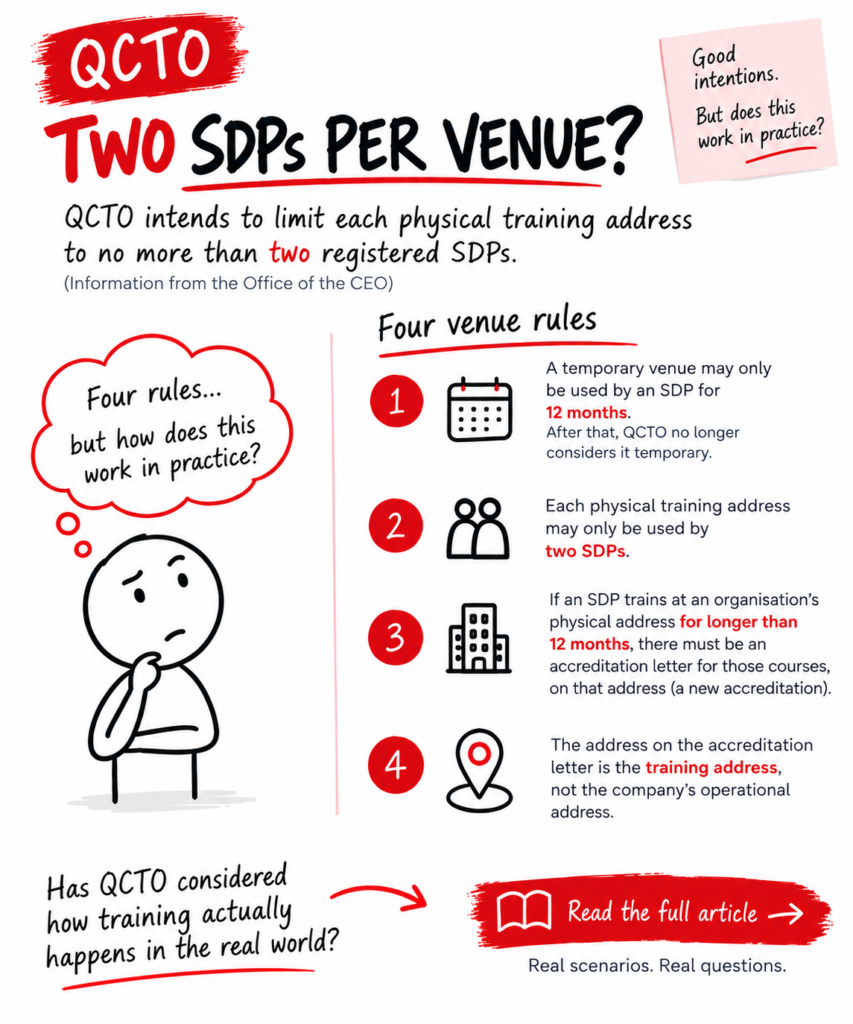
QCTO intends to limit each physical training address to no more than two Skills Development Providers (SDPs).
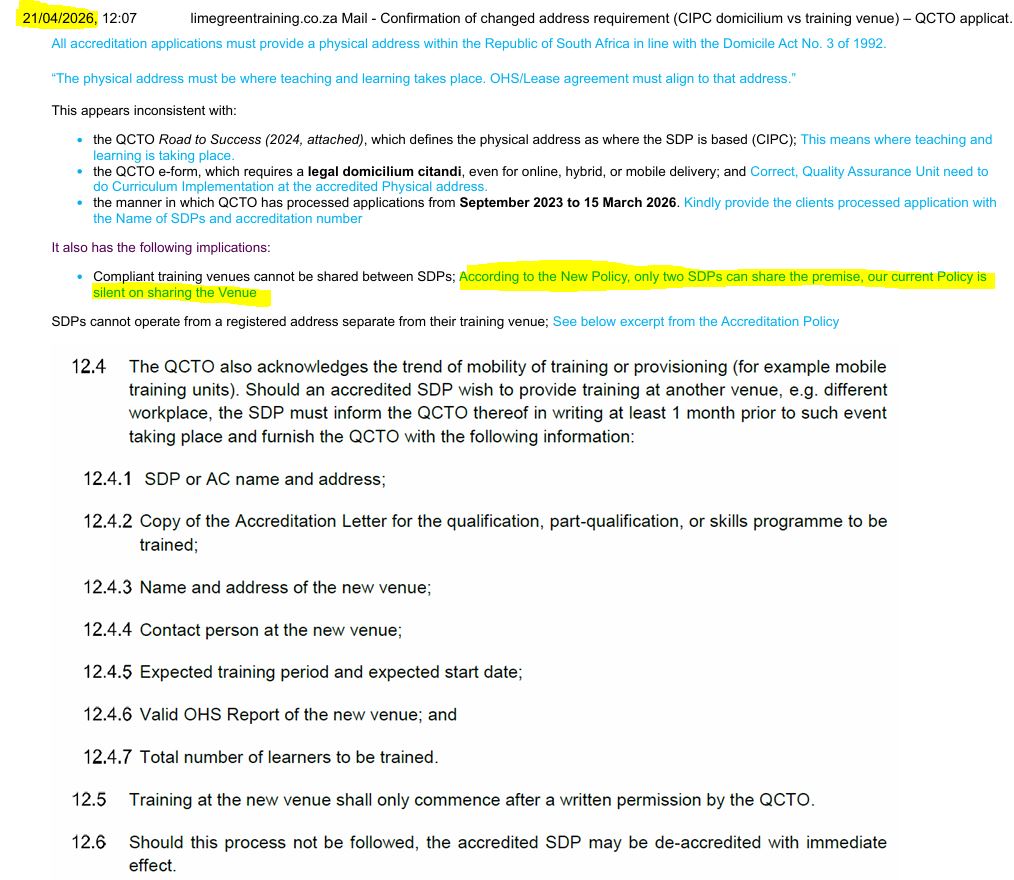
This intention was communicated in writing from the Office of the CEO, Sinnie Machebe. It does not appear to have been implemented yet…thankfully…
There will be four restrictions operating at the same time.
Firstly, a temporary venue may only be used by an SDP for a maximum of 12 months. After that, QCTO no longer considers it temporary, but permanent.
Secondly, QCTO intends to limit each physical training address to no more than two SDPs registered to it (by a QCTO given USI number – although they do not seem to be able to give or track USI numbers yet)
Thirdly, where an SDP trains at an organisation’s physical address for longer than 12 months, QCTO states that there must be an accreditation letter for those courses, on that address (an entirely new accreditation).
And lastly, where an organisation is accredited, the address stated on their accreditation letter is the address at which training takes place, not their operational address, which couples with the point above.
Individually these rules are heavy, but put them together?
Let’s say a company wants a variety of training delivered to its employees at its own premises.
It uses Provider A this year and Provider B next year.
If QCTO implements the two-SDP restriction, has that company now used up its allowance of training providers at its own address? What happens when it wants Provider C?
Or perhaps the same OHS provider returns each year to train new employees. Once the temporary-venue period is exceeded, does QCTO expect the client company itself to become an accredited training provider simply so that it can continue having its staff trained onsite?
And then that company must be accredited for all the training is imports, but may only apply for accreditation for five programs at a time, and if it does not use any of its accredited courses within two years, then those accreditations get pulled (is what it states on the accreditation letter).
I mean, the company isn’t trying to become a training provider. It just wants its staff trained onsite.
Is there ever a meeting at QCTO when they discuss reducing red tape and making education more accessible, rather than adding red tape? In a country where education is in a state and unemployment is among the highest in the world?
The rules get more interesting when you consider how corporate training actually works.
A company might use multiple SDPs – one SDP for OHS, another for Fire, another for Sales, another for Typing, and a completely different provider for Customer Service training.
Companies absolutely do this. I know because I spent years delivering different types of training onsite at corporates, at their own premises, and for different SDPs.
A large employer could quite reasonably use four, five or ten specialist training providers for completely different subjects. Often the training will not all be available from one SDP as training needs are diverse.
The venue belongs to the client, not the SDP. The client should surely be free to choose whichever appropriately accredited providers it needs to train its own employees. And not be limited to two SDPs.
Many private SDPs also hire compliant training venues rather than owning permanent campuses.
How is an SDP supposed to know whether two unrelated providers have already registered that address with QCTO?
You could find a perfectly suitable venue, submit it with your application and potentially be rejected simply because two other SDPs got there first.
Nothing about the venue has changed. Nothing about your ability to deliver the programme has changed. Only the number of providers previously associated with the address has changed.