Before discussing this issue, an important distinction should be made.
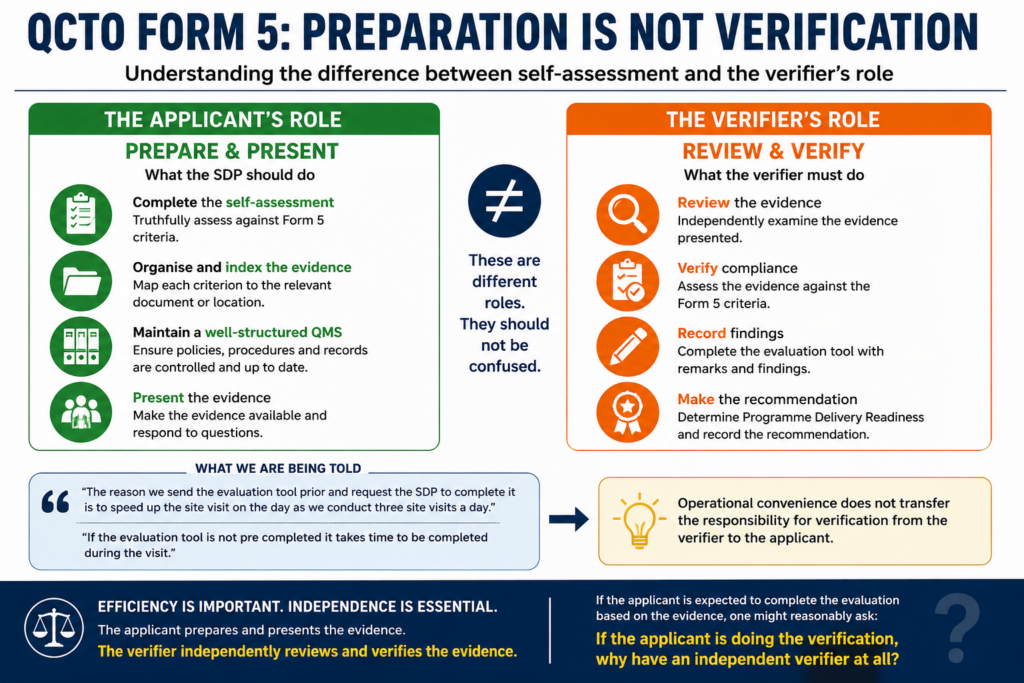
There is nothing unreasonable about an SDP completing its self-assessment, organising its evidence, and indexing that evidence to the relevant QCTO Form 5 criteria. This is good practice and is entirely consistent with the QCTO Road to Success guide.
The concern arises when applicants are expected to complete the verifier’s remarks and findings on the evaluator’s behalf, on QCTO Form 5 instead of preparing and presenting evidence.
According to the QCTO Road to Success guide, the purpose of the site visit is for the applicant to present evidence and for the verifier to evaluate that evidence using Form 5. The roles are therefore clear: the SDP prepares the evidence, and the verifier independently reviews and records the findings.
Recently, however, some providers have been told to pre-complete the evaluation tool with verifiers remarks, and beyond self assessment. And when challenged on it, the reason given is:
“The reason we send the evaluation tool prior and request the SDP to complete it is to speed up the site visit on the day as we conduct three site visits a day.”
and:
“If the evaluation tool is not pre completed it takes time to be completed during the visit.”
These are understandable operational concerns, but they are not policy requirements. Indeed, one recent response by a verifier acknowledged:
“You are correct to say that the evaluation tool is to be completed by the verifier…”
This admission is important.
There is a significant difference between supplying factual information and performing the verifier’s role. There is nothing unreasonable about providing company details, qualification information, or maintaining a well-indexed evidence file. An evidence index does not replace the audit; it simply makes the audit easier.
The verifier is effectively relieved of the responsibility to independently verify the evidence if the applicant is expected to interpret the evidence, write the findings, and complete the evaluation remarks. In other words, if the applicant is expected to complete the evaluation based on the evidence, one might reasonably ask:
If the applicant is doing the verification, why have an independent verifier at all?
Efficiency is important.
Independence is essential.
The two should complement one another, not replace one another.