Business has gone a little quiet… That client who used to book every few months hasn’t been back. Another asked for a quote. You gave them excellent pricing, but they still ghosted you. Referrals aren’t coming through quite as often.
Your full-time facilitator left and now looks a little more relaxed in general when you see her around. Freelancers seem reluctant to commit to train for you. One even did a no-show last week – venue booked, class arrived, no facilitator!
You wonder if it’s just a quiet period that will end. Maybe its the economy or just ‘people’. Maybe your competitors are undercutting you, maybe it’s AI, global politics, or something else. You’re accredited, your receptionist is friendly, and you even renovated your website. Why does business just seem to be slowly getting harder…?
You’d love to spend time on this problem, but you’re also swamped dealing with the QCTO assessment department over the FISAs from your last cohort, which they say were not unique enough…
What if the problems you’re dealing with all lead back to the same place?
Can your facilitator actually teach from the material? Does it properly cover the curriculum with real teaching that is in line with industry best practice, legislation, guidelines, and what is known to be true? Does it have good lesson flow? Is it pitched at the correct NQF level and course duration.
Was instructional design applied? Was anyone involved in the writing process actually qualified to develop the material? Is it aesthetically pleasing, engaging, and easy to navigate?
– Surprisingly, yes, some material does all of the above…
Or…
Does it look like most of the material on the market? Written in the 90s, or wildly and frantically copied and pasted from websites and blogs, then circulated for years. Or perhaps it is newer material where AI was used without any meaningful supervision. Nothing verified or checked; just accepted, pasted, and done.
Often it has been passed between cheap vendors who pirate from one another. I often doubt whether the person selling it has ever actually looked at what they are selling. How can they? Many claim to have thousands of manuals. How many have they even opened? Their USP almost always seems to be “cheaper, cheaper, cheaper!”
– You bought the material. Now this is your zoo, and those are your monkeys.
It is absolutely possible it passed, but that is not where it really counts and where the problem begins and ends.
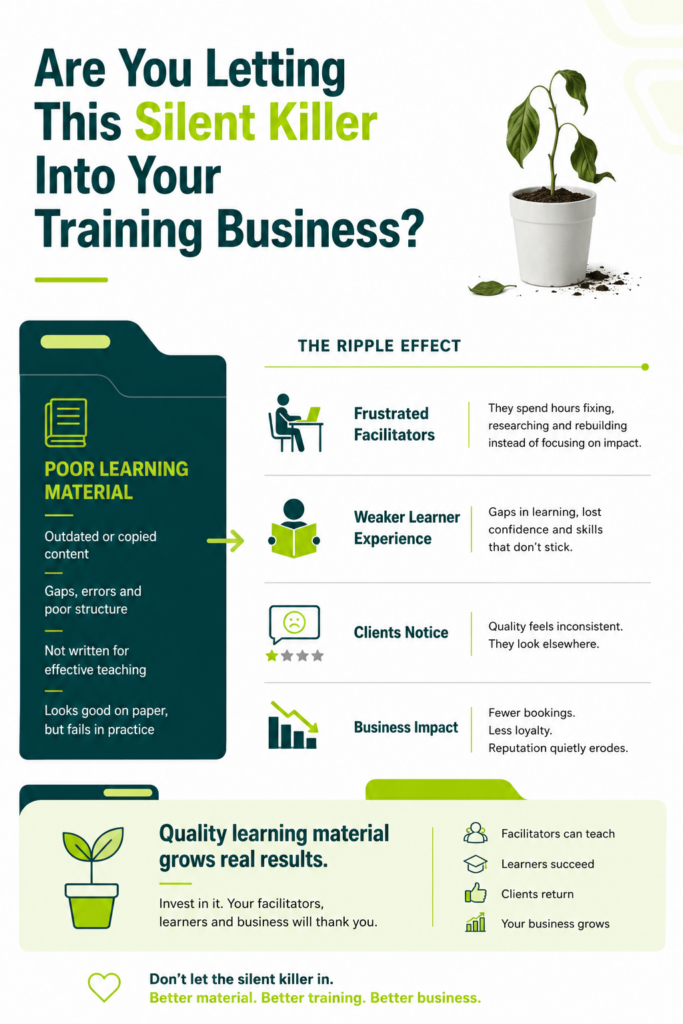
Interestingly, it is usually the facilitator who is first in line to bear the brunt of poor learning material. They are handed the material, often shortly before training, and expected to make it work. Missing content has to be researched, errors corrected, activities created, explanations improved and lessons restructured – almost always it seems – at the last minute. The facilitator ends up doing the development work that should have been completed before the material was ever sold.
I know, because I was that guy. Fixing material late at night for an 8am class, repeatedly asking the wind, “Who wrote this? I mean… this code doesn’t even compile!” Is that what your facilitators are saying about your material? E.g. Its no wonder that some facilitators now refuse to train First Aid unless the provider is using Lime Green material. I’ve seen providers purchase our material for precisely that reason – their facilitator. (With First Aid, medical accuracy is simply not negotiable.)
The learner often pays the price too. If the facilitator does not have the time, subject-matter expertise or resources to repair poor material, those shortcomings flow directly into the classroom. Learners receive poorer training, miss important knowledge or practical skills, and may ultimately be assessed on outcomes the material never properly taught them in the first place. And very often, the learning material will be the reason why.
At first, this can still look like somebody else’s problem. You achieved accreditation, the facilitator somehow delivered the course, and the learners completed it. QCTO gave you some flak, but you eventually got through that too. Yet over time, the quality of your learning material can become the silent killer and the reason facilitators don’t want your bookings, learners don’t return, and clients quietly go elsewhere.
Doing business in South Africa is no joke. You’re competing with people who aren’t even accredited but claim to be, while undercutting your pricing. Marketing costs a fortune, everything is expensive, QCTO doesn’t treat your time like its money, and margins matter. So what a relief when someone offers you learning material for one rand per credit. (I’m not kidding – I’ve seen it even cheaper than that.)
And that is the crux. You drank the Kool-Aid. You thought you’d found one place where you could save because you’d already spent so much everywhere else. But what you actually did was invite the silent killer into your business.
Cheap material doesn’t remain a cheap purchasing decision. It follows you into the classroom. Your facilitator inherits it. Your learners experience it. Your clients judge you by it. And eventually, your reputation carries the cost of somebody else’s shortcuts.
Good learning material isn’t just something you buy to get through accreditation. It is part of the product you sell. Invest in it accordingly.
Ok, this is a constructive question:
Before you go shopping, beware. Price can be an indicator of quality, but it certainly doesn’t guarantee it. I’ve seen some remarkably poor material sold at remarkably high prices as well. Always ask for samples and take the time to properly examine what you’re buying before you commit.
And if you can’t get a decent sample to examine in your own time, why are you buying it?
Don’t book a meeting and let a salesperson pour honey in your ear. Get the sample and read it in your own time. Is there a clear, visible heading hierarchy? Does the material align directly with the curriculum modules, or is the content sporadic and difficult to map?
Read the content underneath those headings and ask whether it actually teaches the learner something. Poor material often simply paraphrases the curriculum requirement without teaching it, or talks around the subject without ever explaining the subject itself. “Fire safety is an important aspect of workplace safety. Employers should ensure that appropriate fire safety measures are implemented and employees understand the associated risks.” Fine, but what are the fire risks, what measures are required, and what must the learner actually do?
The question isn’t “Is this topic mentioned?” but “Could someone actually learn this topic from what is written here?”
Speaking as a facilitator: We know when you’ve given us rubbish. We may complain loudly, grumble under our breath but fix it before the class, or say nothing at all…but we know. And if the material affects the quality of the training, your learners know too. Eventually, so do your clients. And later your accountant will know too.
If this sounds like your business, buy better material, develop better material yourself, or train fewer programmes and do them properly. Give your facilitators something worth teaching from and your learners something worth learning from.
And perhaps learning material developers could take the same approach: develop fewer programmes and develop them exceptionally well, rather than offering hundreds of programmes that aren’t good value even if they were completely free.
If none of this sounds like your business, carry on as you were. Maybe you never let the silent killer in.