Yes.
After several years of watching the unit standard to QCTO transition unfold, one lesson has become clear to me.
The industries that helped establish new, replacement QCTO programmes are definitely better positioned today than those that simply waited for government to sort things out or extend their programs.
That is not a criticism of training providers. Government has handled much of the transition poorly.
Communication has been limited, decisions have often come late, and businesses have had to continue serving clients and generating income while operating in uncertainty.
Nevertheless, helping establish the replacement programmes tends to produce better long-term results than waiting for somebody else to do it.
People often speak about the SETAs handing over to the QCTO, but that is not really accurate.
SETAs still play a major role as Quality Assurance Partners (QAPs). In many cases, you apply to the QCTO, but your audit is conducted by the relevant SETA. The SETA is also usually the body that initiates and participates in curriculum development.
Govt has moved from a system where SETAs controlled accreditation and certification to one where QCTO controls accreditation and certification.
SETAs continue to perform many quality assurance functions. This means your SETA remains very important.
My recommendation has long been simple.
Put 90% of your effort into helping establish the programmes you need.
Put 10% into trying to save the unit standards.
Unfortunately this has absolutely proved true since I posted it years ago. Many programmes have disappeared despite considerable efforts to save them. At the same time, many replacement QCTO programmes have emerged, and those industries have generally been able to adapt to the change rather than having the rug pulled out from under them.
In theory, the SETA and QCTO should do this work themselves, funded by the Skills Development Levy.
When they do not, this is the recipe that has worked for me in the past. I no longer offer this as a consulting service. I am simply sharing the process because I have seen it work and have had success following it.
Before embarking on this journey, be realistic. If your proposed programme serves only your own organisation, is highly specialised and niche, or lacks broader industry support, it is unlikely to succeed. The SETA and QCTO will generally want to see wider industry value.
Programmes that have a better chance of being taken seriously are those that can be linked to govt buzz words like “job creation”, “employability”, “skills development”, “economic growth”, “youth development”, as well as “scarce but critical skills”..whether accurate or not. Ie. I directly recommend you try link your program to govt buzz words.
It also helps if your proposal aligns with whatever plans and strategies government is currently promoting, such as the National Development Plan . Whether those plans actually achieve much is another matter, but governments do like plans.
You should absolutely NOT attempt this alone. A single organisation advocating for a programme is easy to ignore. Involve other stakeholders, including your competitors and anyone else who would benefit from the programme.
The more industry support you can demonstrate, the greater the likelihood that the SETA and QCTO will view the programme as having genuine industry value.
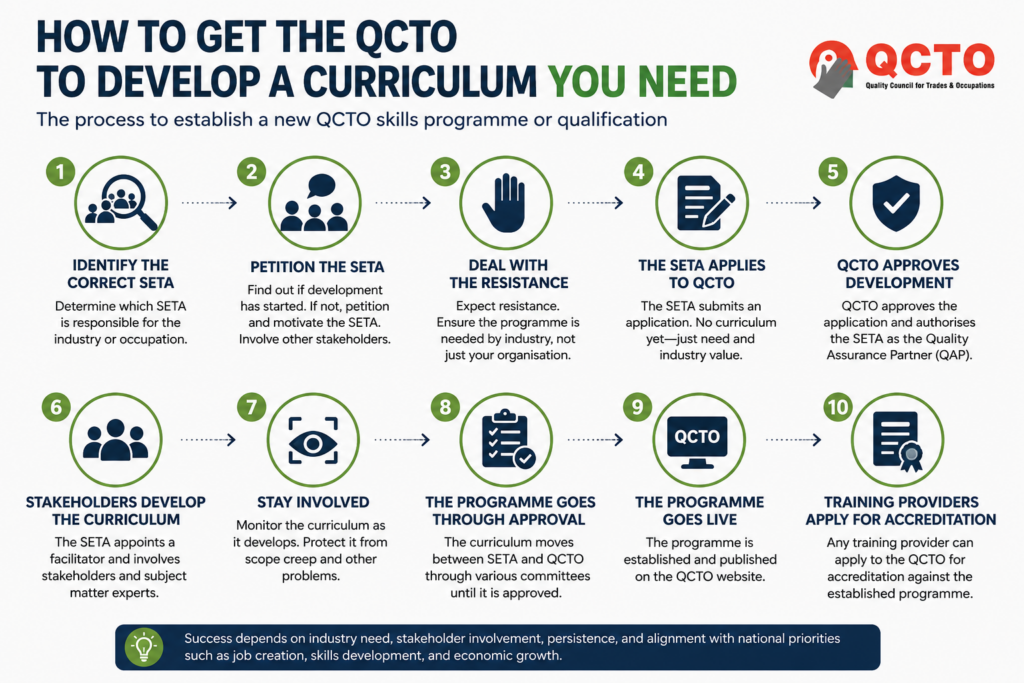
Locate the SIC code for your program and find out who the relevant SETA it. E.g. First aid is HWSETA, Lift trucks is TETA, Working at heights is CETA. Locate SIC codes here.
Find out whether development has already started. If not, petition and motivate the SETA to submit an application to QCTO to develop the programme. Involve other stakeholders. Twenty organisations are harder to ignore than one.
This is where most projects live or die. You are creating work for somebody, so expect resistance. Some SETAs are receptive, while others are not. Locate the person at the SETA that handles this, and follow up with them regularly to make progress.
If your motivation goes well, the SETA submits an application to QCTO to develop the programme. At this stage there is no curriculum yet. The application simply motivates the industry need and value of the programme.
If QCTO agrees, the SETA is authorised to proceed as the Quality Assurance Partner. If you get here, you have already achieved a LOT. Well done. This is what the form looks like for an approved program.
It now becomes about what the QCTO curriculum says, rather than if there will be one. The SETA appoints facilitators and stakeholders become involved. This is where subject matter experts need to participate and work together on the actual content.
Do not disappear. Constantly follow up, ask for updates etc. You are developping a program and that tends to be a stop start process. Develop the entire curriculum for the SETA if you must, and then just ask them to approve it.
The curriculum moves back and forth between the SETA and QCTO through various committees and approval structures until it is finally established. Patience is required. Note that once it is approved it is virtually impossible to change.
Eventually the programme appears on the QCTO website as an official skills programme or qualification.
NB: Do not let others do the hard work of motivating and developing a programme, only to complain about it afterwards, or even try tear down what others spend months and years getting done. (I am looking at you Ken). If you want the curriculum to look the way YOU want, put in the effort while it is being built.
It is now live and anyone can apply for accreditation against it! From here you start your QCTO accreditation process.
This process can take years from start to finish. You will need to have a system where you have a reminder to ping it at least weekly, and get actively involved at stages where progress is being made.
Over the years I have participated in several successful projects, initially for clients and later for industry, funded by my own office.
Examples include:
Occupational Screening Testing in Spirometry (SP211002)
The three First Aid skills programmes
Eleven short OHS programmes
These projects convinced me that while the process is frustratingly slow, it does work.
By all means, sign petitions. Fight for more extensions. Maintain your SETA accreditation where possible.
But most of all, help establish the programmes your industry needs.
Going through the door is generally more productive than throwing a brick through the window.