
CIPC vs training venue for QCTO accreditation. If you’ve been confused about which address to use, you’re not alone. The wording in QCTO documents is unclear, and based on real application outcomes, the way addresses are handled by QCTO has not been consistent at all.
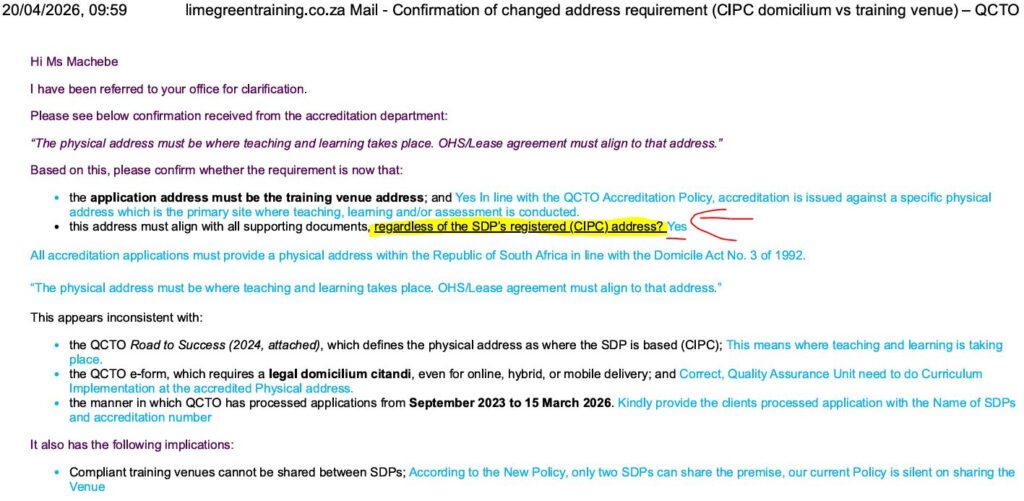
In an escalation that lasted about three weeks, the office of the CEO stated that the application address must be the training venue, and that all supporting documents such as OHS reports and lease agreements must align to that address, regardless of the SDP’s CIPC domicile address (their operational address).
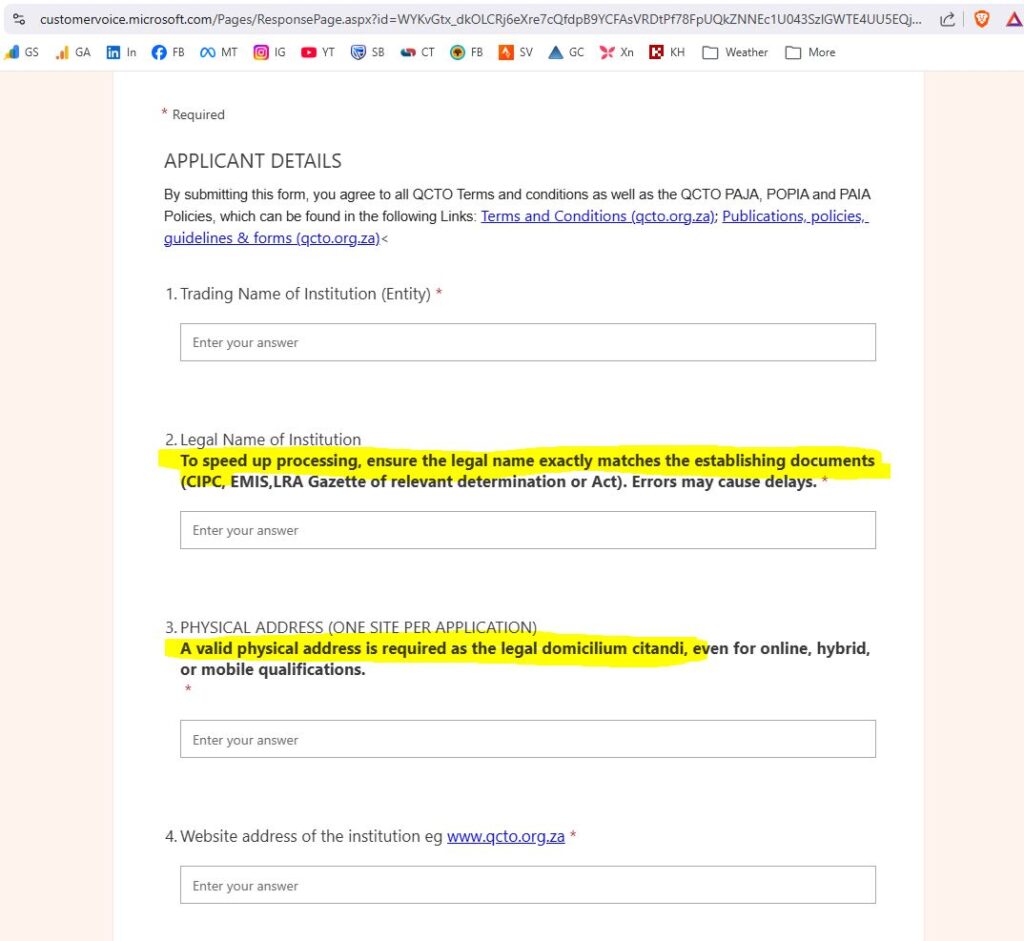
This directly contradicts QCTOs e-form which calls for the “legal domicilium citandi”, which means “legal home for summoning”.
Also note field 3 comes straight after field 2 which directly calls for CIPC address alignment.
This is clear messaging by the author of this e-form that it is about your operational address. To say it is not requires some gymnastics.
This is the e-form applicants seeking accreditation for skills programs apply on, note highlighted text:
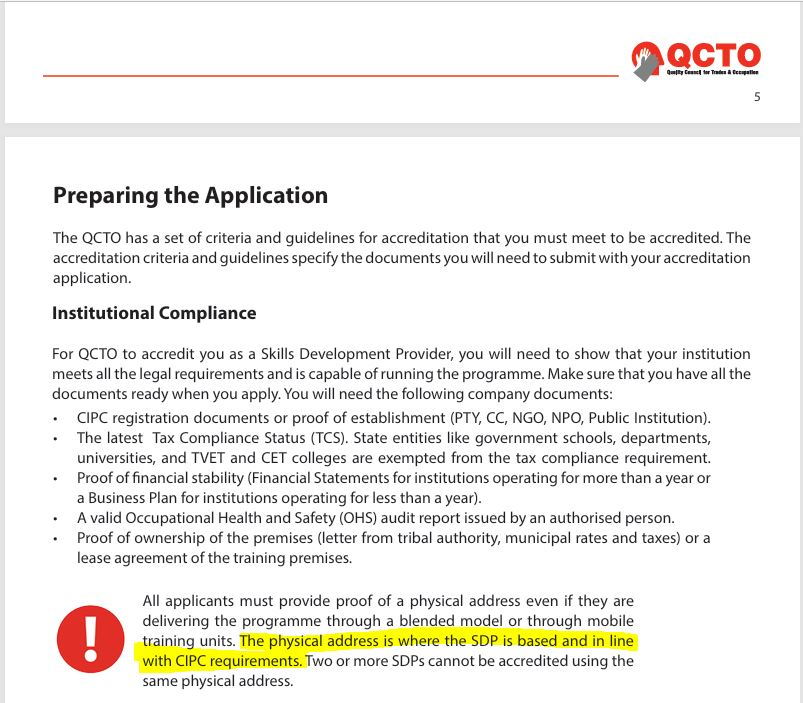
The contradiction continues in the QCTO guidance document “Road to Success 2024” (latest version) which defines the physical address as “where the SDP is based in line with CIPC requirements“. See highlighted text
QCTO’s interpretation assumes a campus-style setup for all training organisations, which is often not the case, particularly for private providers offering short courses, whose practical realities are frequently overlooked in policy.
The contradictions and inconsistent historical application of the policy were not addressed when this was escalated at QCTO. Although a clear written response was eventually provided by the CEO’s office as shown above, questions regarding these inconsistencies were still repeatedly avoided, even when reframed.
The one positive outcome was that QCTO confirmed the CIPC address does not need to match the training venue, avoiding a more restrictive requirement that would place additional pressure on private providers offering short courses and using hired venues.
In practice, QCTO has applied address requirements inconsistently across training providers, with no clear trend over time.
I conducted a case study across 57 private training providers whose applications were submitted and completed between September 2023 and March 2026. They are all private training providers training short courses.
There are three possible addresses in each application:
Cases where all three addresses were the same were identified and then excluded, as no discrepancy was likely.
For the remaining cases, the address reflected on the accreditation letter shows that QCTO actively selected and, in many instances, changed the applicant’s address from what was originally submitted on the e-form:
It should be noted that item 3, where QCTO used the CIPC COR 14.3 address, is particularly significant because this case study was triggered by QCTO rejecting applications that included the CIPC address on the e-form, requiring applicants to start the process from scratch. However, the data shows that QCTO can and does amend the address at a later stage, and in these instances, they voluntarily applied the same CIPC address.

When submitting a new application, it becomes a bit of a lottery as to which address will ultimately appear on your accreditation letter, which has implications later.
Where you use a compliant training venue on an ad-hoc basis QCTO now considers that venue as your main address and the address with which to interact with you. And you could run into trouble if someone else happens to be using the same hired venue.
QCTO has rejected applications and required applicants to return to the back of the queue for using an address different from what the accreditation department expected at that specific time, despite:
When it comes to learner enrolment, the assessment department may flag or block learner certification due to address discrepancies, as they do for other self-caused compliance issues.
This will easily result in a compliant and competent learner not receiving a certificate. QCTO will not acknowledge the error may be on their side and the administrative burden of it will fall to the learner and the private training provider as described in this article you are reading, and also this article (Diane’s compliance trap).
This must be emphasised: an issue originating in one QCTO department, such as address handling, will not be recognised or excused by another QCTO department, such as the assessment department during learner enrolment.
QCTO will proceed to reject the submission and place the burden on the training provider to resolve it.
QCTO also runs campaigns to clamp down on fraudulent private training providers, which is a valid objective (and should be extended to government institutions and departments as well as government providers and instututions).
If the QCTO does not record the provider’s domicilium citandi et executandi, how does QCTO intend to enforce legal action against non-compliant training providers – they cannot even send a legal letter.
To be clear, QCTO is saying that the CIPC / operational address is not to be captured on the e-form, and, in some cases, applicants are penalised for providing it.
This policy does not suit private training providers offering short courses, who use compliant ad hoc venues for delivery while operating from a CIPC-registered operational address.
Many training companies also provide a range of services beyond training, making a single, fixed training venue impractical. This creates the need to explain why their QCTO accreditation letter reflects a different address from their operational address, which will come up in their sales process.
Accreditation is intended to be built on accountability, structure, consistency, standards, quality, and objectivity.
Where these elements are not consistently reflected in how requirements are applied, trust in the relationship between training providers and the QCTO begins to erode.
Private training providers are then placed in a defensive position. Instead of focusing on delivering quality training, the emphasis shifts toward managing administrative uncertainty, being penalised for issues beyond their control, second-guessing QCTO publications, and trying to avoid rejection as policy becomes a moving target.
This impact does not stop at the provider level. The learner also carries the consequence. Administrative uncertainty at accreditation stage can lead to delays, rework, and disruptions to enrolment, delivery, and certification.
In that sense, inconsistency at process level moves beyond administration and begins to affect the very outcomes that accreditation is meant to protect.
These dynamics also raise broader questions around accountability, communication, and service within the accreditation process, which are explored further in the next article on QCTO accountability and customer service.
QCTO needs to change its attitude and properly recognise private training providers, particularly those delivering short courses, as customers who require both service and administrative fairness.
In practical the address issue is a simple information systems fix. If QCTO can list multiple qualifications and skills programs on an accreditation letter, it can just as easily list multiple approved training venues.
This is really not a complex issue for QCTO to solve, but meaningful solutions are unlikely until there is a shift in mindset at QCTO. The address issue is a long-standing concern among training providers, and not only those offering short courses.
The current administrative burden is extremely excessive. To use an additional permanent venue, a provider is required to submit a full application, which can take 3 to 6 months, often closer to 6.
Instead of treating this as a simple venue addition, QCTO treats it as a completely new application, placing unnecessary strain on both providers and its own capacity.
While QCTO has made allowances for temporary training venues, this use is limited to a one-year period. Although this concession is welcome, it remains poorly implemented and only shows they can make this more practical, but choose not to.