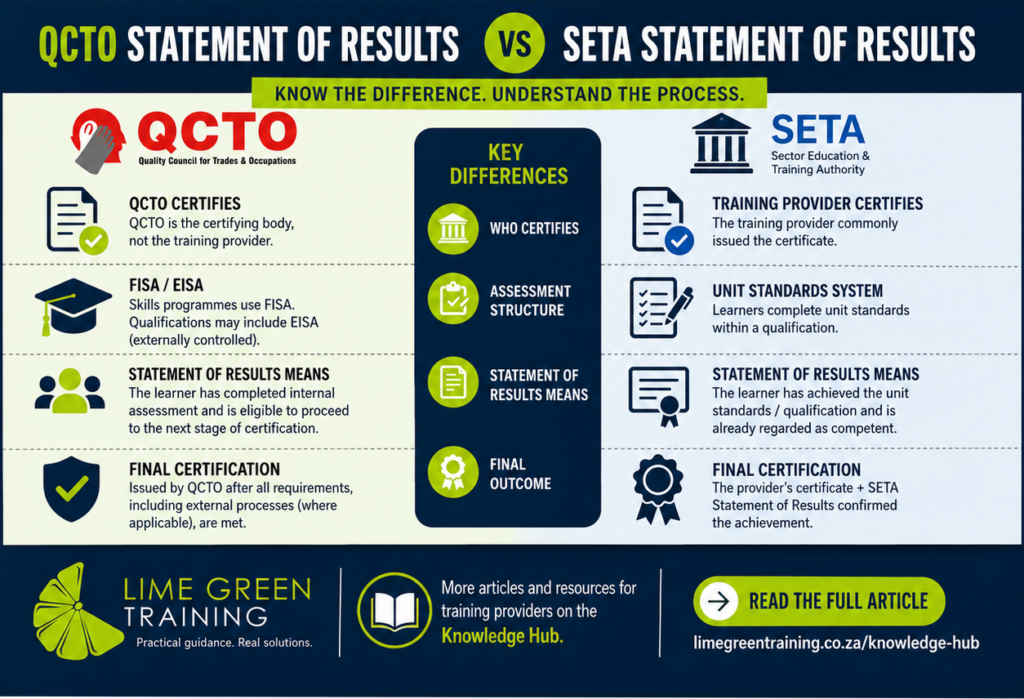
The meaning of a Statement of Results changed significantly under the QCTO system. Learn the difference between QCTO and SETA Statements of Results, including how FISA, EISA, certification, and learner competency are handled under each framework.
Many training providers still approach the QCTO environment using assumptions carried over from the older SETA unit standard system. This is understandable, because the two systems can appear similar on the surface while functioning very differently behind the scenes.
One of the biggest areas of confusion relates to Statements of Results, certification, and the difference between internal and external assessment under QCTO.
Under the older SETA-based environment, training providers were commonly accredited against qualifications made up of individual unit standards.
Once learners successfully completed those unit standards, the training provider would often issue the learner certificate directly. The SETA would then issue a Statement of Results reflecting the learner’s completed achievements.
In practice, the Statement of Results generally confirmed what the learner was already regarded as competent for.
This created an industry understanding that:
“Statement of Results = learner already qualified.”
Under the QCTO system, however, that assumption is not correct.
Under the QCTO framework, QCTO is the certifying body, not the SDP.
The training provider conducts training, internal assessment, moderation, and administrative processes under the approved curriculum framework. However, the final certification process is controlled through QCTO structures and processes.
This creates an important distinction between:
For QCTO skills programmes, learners complete a FISA (Final Integrated Supervised Assessment). This is the final internal assessment conducted by the SDP.
For occupational qualifications, learners complete internal assessment processes before proceeding to an EISA (External Integrated Summative Assessment), which is externally controlled and forms part of the final certification process.
External here means it is conducted by the SETA or partner appointed by the QCTO, and not the training provider who trained that learner.
Internal here means conducted by the training provider who trained the learner.
This means that successful completion of internal assessment processes does not mean the learner is already certified.
Under the QCTO environment, a Statement of Results (SoR) reflects that the learner has completed the required internal assessment processes and may proceed toward the next stage of certification.
For occupational qualifications, this may include eligibility to proceed toward the EISA process.
This differs from how Statements of Results were commonly understood under the SETA system.
Under QCTO, a Statement of Results does not necessarily mean:
“The learner is fully qualified.”
Instead, it may mean:
“The learner has met the requirements to proceed toward final certification.”
This distinction matters because many administrative, accreditation, and certification misunderstandings arise when providers apply older SETA assumptions to the QCTO system.
Under QCTO:
Understanding these differences helps providers better understand learner status, certification processes, Statements of Results, and the broader structure of the QCTO system.