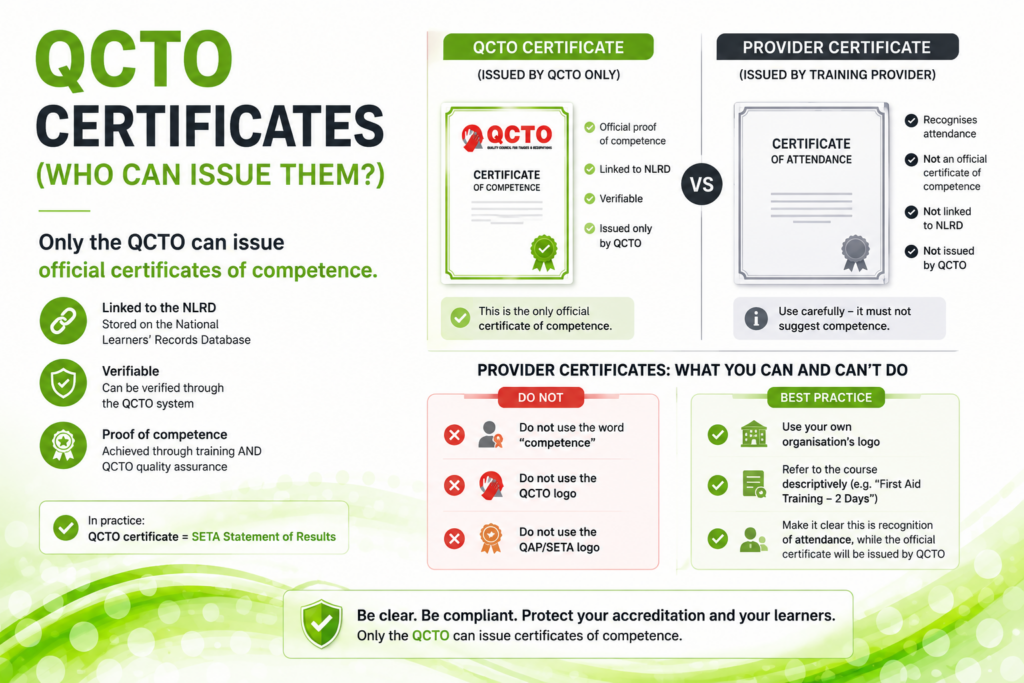
When you receive your QCTO accreditation letter, you may notice the red text stating that your organisation cannot issue QCTO certificates. This often causes confusion for new Skills Development Providers (SDPs). The simple answer is: only the QCTO can issue QCTO certificates.
You can still provide certificates to your learners, but they cannot be presented as official QCTO certificates.
Quick note: This article is part of the larger Post-Accreditation Guide and should be read alongside What is QCTO Accredited Training?.

QCTO certificates are unique documents that:
Link directly to the National Learners’ Records Database (NLRD)
Are verifiable through the QCTO system
Confirm that the learner has achieved competence through both training and QCTO’s quality assurance process
In other words, competence is not only about attending training. Learners must achieve every curriculum outcome and pass through the QCTO’s verification steps before competence is officially recognised.
Under the SETA system, many providers issued their own certificates, while the SETA issued the Statement of Results (SoR). The SoR, and not the provider’s certificate, was the real evidence of competence, because it was linked to the NLRD.
Unfortunately, some providers issued certificates even when learners were not competent, or when the provider itself wasn’t properly accredited. This undermined credibility. In other cases, the SETA had issues and did not issue statements of results even though the learner could be proven as competent.
The QCTO changed this by making its own certificate the only valid proof of competence. In practice, the QCTO certificate = the SETA Statement of Results.
The system is not perfect. Delays at QCTO are common, and the evaluation of results can be overly bureaucratic, sometimes missing the point and the very outcomes it was designed to achieve.
Yes! You can still give your learners a provider-issued certificate, but it must be carefully worded and designed.
 Do not use the word “competence.” Use “Certificate of Attendance” instead.
Do not use the QCTO logo. Only QCTO issues certificates with its logo.
Do not use the QAP/SETA logo linked to the programme.
Doing any of these could mislead learners and risk your accreditation.
 Use your own organisation’s logo.
Refer to the course descriptively (e.g. “First Aid Training – 2 Days”), rather than using the QCTO skills programme code, NQF level, or credits.
Make it clear that this is recognition of attendance, while the official certificate will be issued by the QCTO.
This may feel restrictive, but it ensures learners are not misled and protects your compliance. In the end, the learner will receive the official QCTO certificate of competence once the process is completed.
Only the QCTO can issue official certificates of competence. Training providers can issue certificates of attendance to recognise participation, but these must not resemble QCTO certificates or suggest competence.
Being clear and compliant protects both your business and your learners , and ensures the value of QCTO certificates remains trusted nationally and internationally.
Also see this article explaining what QCTO accredited training is.